Your AI Chatbot Can't Help the Customer — Now What? 4 Rules for a Human Handover
An AI chatbot answering customers 24/7 is a real win — until it can't help, and the customer has no way to reach a person, or has to repeat everything after a clumsy handover. Two large 2026 surveys agree: customers accept AI, but they expect a human to be one tap away when it matters.
▶ Watch: the short version
Customers accept AI — but want a human on standby
In Zendesk's CX Trends 2027 research (over 3,100 consumers across 10 countries), 88% of consumers want a human available if needed. Gartner found much the same: in a survey of 3,566 customers, 87% say it's essential for companies using generative AI to offer a way to reach a human agent.
The cost of getting it wrong is real. Customers can tell within seconds when a bot is guessing, and a single confidently wrong answer can do more damage than a slow human reply. Customers pushed through repeated failed AI interactions before reaching a person are less likely to use that tool again.
4 rules for a human handover that works
Keep AI for the easy questions, and make the human path effortless:
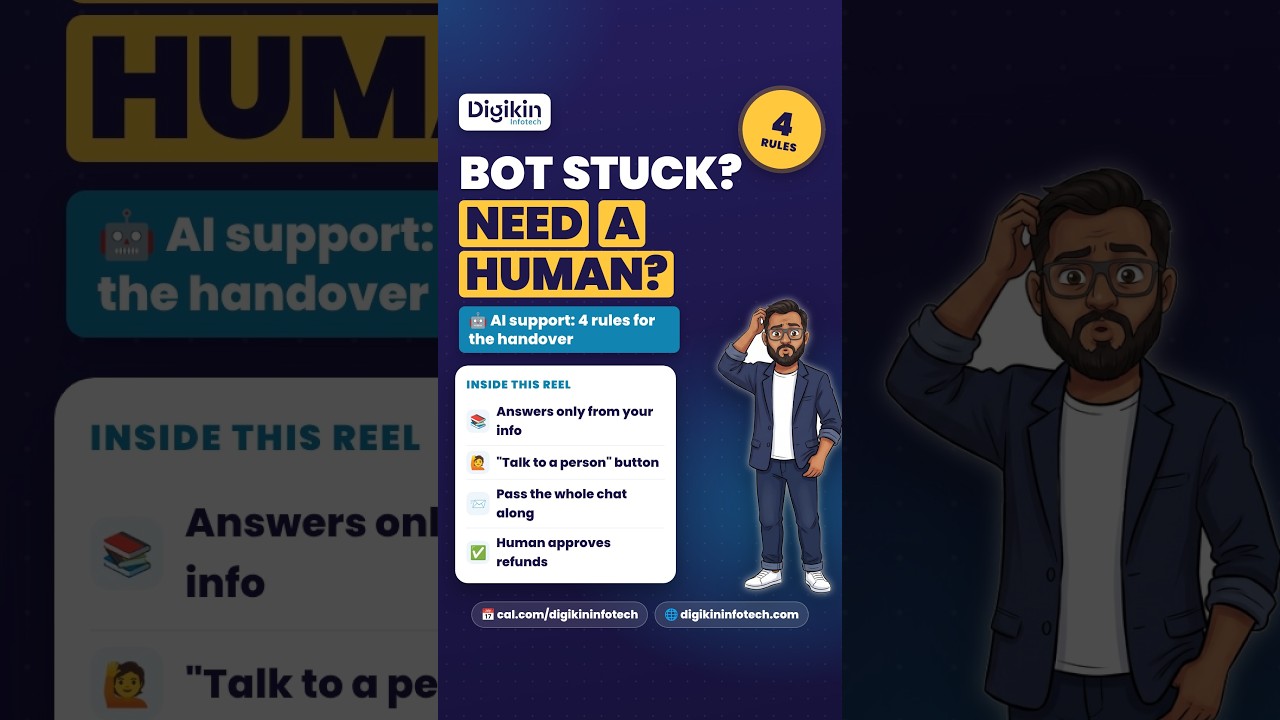
- Answer only from your own approved information (orders, policies) — never let the bot guess.
- Give an always-visible "talk to a person" option, with no loops or dead ends.
- Hand over the full chat so the customer never has to repeat themselves.
- Require a human to approve refunds, cancellations, and account changes.
The takeaway
AI for the easy questions, a human one tap away for the rest. That balance is what keeps customers trusting your support instead of abandoning it.
"Customers can tell within seconds when a bot is guessing."
Sources
Adding an AI assistant to your support? See how we integrate AI with human handover →