People Still Search for What You Sell — But Fewer Click. 4 Fixes for the AI-Search Era
People still search for what you sell. Fewer of them click through to your website. Google's AI Overviews and AI Mode, plus assistants like ChatGPT, increasingly answer the question right on the results page — so the visit that used to land on your site never happens. For a small business, that's real traffic quietly disappearing, and it's not obvious what to change on your own website to win it back.
▶ Watch: the short version
About 1 in 3 owners say AI search is cutting their traffic
A September 2026 Small Business Expo survey of 3,608 small business owners found 33.9% noticed a decline in website traffic they believe is related to AI-generated answers (12.9% called it significant). Another 14.8% said an AI result showed incorrect information about their business. These are owners' perceptions rather than proof of cause — but the worry is widespread and consistent.
The shift behind it is measurable: Pew Research Center found users clicked a traditional search result on just 8% of visits when an AI summary appeared, versus 15% when it didn't. The practical advice from the coverage (Forbes): check Search Console for pages that lost clicks, and build an audience you own, like an email list, rather than depending on search alone.
4 fixes so AI search still sends people to you
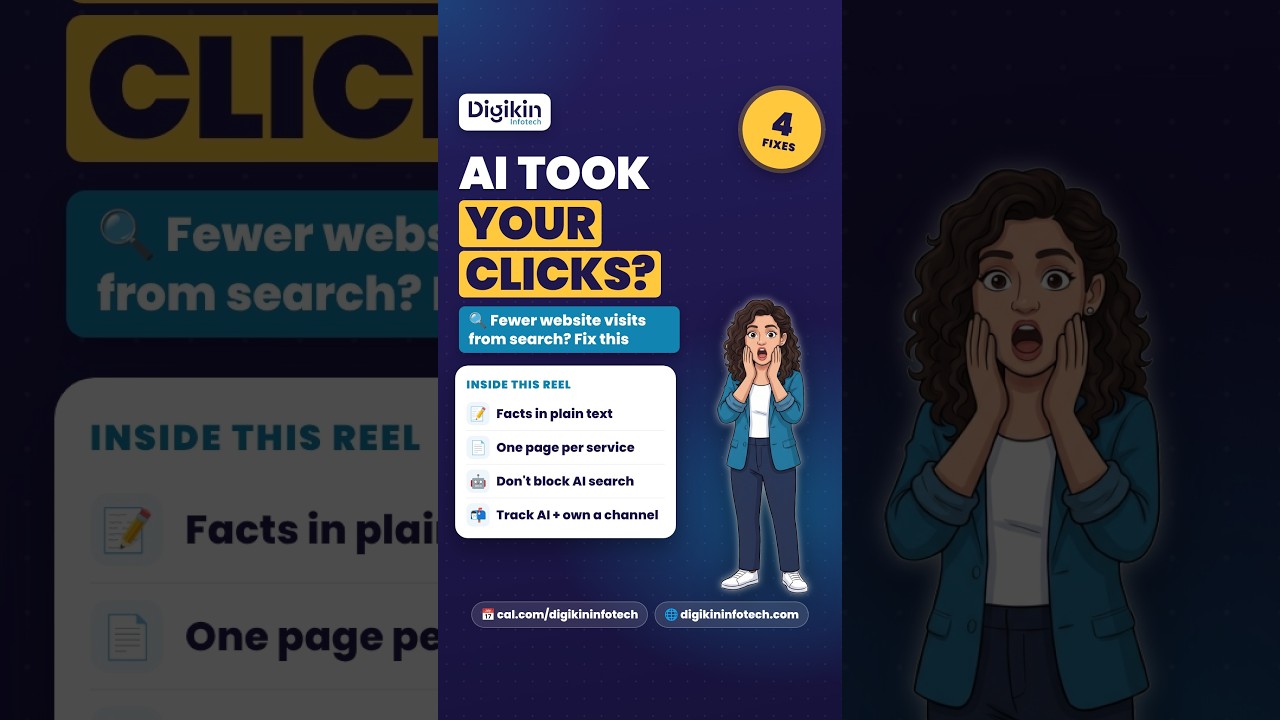
You can't stop AI from summarizing the web. You can make sure it reads your business correctly and still points people to you:
- Put your business facts — name, services, location, contact — in plain text, not locked inside images, sliders, or scripts.
- Give every service its own page, so AI can cite the exact one instead of guessing.
- Don't block AI search crawlers in robots.txt — blocking OpenAI's OAI-SearchBot, for example, removes you from ChatGPT search entirely.
- Track AI visits (ChatGPT referrals show up as utm_source=chatgpt.com) and own a channel AI can't gate — like an email list.
The takeaway
AI answer engines can only cite what they can read. Put your facts in plain text, give each service its own page, keep the crawlers allowed, and build a direct channel — so when AI answers the question, your business is the source.
"If AI can't read your website, it can't send people to it."
Sources
- Small Business Expo — "1 in 3 Small Business Owners Say AI Search Is Cutting Into Website Traffic" (survey of 3,608 owners, 29 Sep 2026)
- Forbes — "Google AI Overviews Are Eating Your Website Traffic. Here's How To Get That Traffic Back" (18 May 2026)
- LovedByAI — "The State of AI Traffic for Small Businesses 2026" (updated 9 Sep 2026)
Is your website invisible to AI search? See how we rebuild small-business sites for search & AI →